
What we do know is that even if there wasn't a conspiracy, skeptics still have to account for the numerous anomalies of the official investigation into Kennedy's death.

Many such anomalies were amplified by the independent reinvestigation of Louisiana district attorney, Jim Garrison, which would ultimately lead to the trial of CIA contract agent, Clay Shaw.

In fact, the report of the House Select Committee on Assassinations, (HSCA) which reinvestigated Kennedy's death in 1979, concluded that there was a "high probability" that two gunmen were involved in the assassination. The official narrative itself admits to there being more than one shooter, by proxy admitting to the efforts of the Warren Commission (WC) to cover it up.

Until then, we were supposed to believe that the bullets came from behind the limo from the Texas School Book Depository, (TSBD) however Kennedy's autopsy photos clearly indicate trajectory from the grassy knoll.

Watching the Zapruder film shows the same.

Dr. Charles Crenshaw, who helped perform Kennedy's autopsy testified that the president's wound entered the front of his head and exited from his lower neck.

Dr. Robert McClelland said the same.
Doctors in DC, where Kennedy's body was flown Contradicted Crenshaw, regarding the hole as an exit wound. This confusion was explained in 1997, when it was revealed that former President Gerald Ford, who at the time was part of the Warren Commission, rewrote the position of the exit wound to be ''at the back of his neck'', in order to "clarify meaning".


Magic Bullet - The Warren Commission concluded that Lee Harvey Oswald fired three shots from behind Kennedy, one which missed injuring James Tague, another which killed Kennedy, and a third supposedly responsible for seven other entry and exit wounds.

This notion, known as the Magic Bullet theory, was authored by (((Arlen Specter))), who upon his death was mourned by the Israeli embassy as an unswerving defender of the Jewish state.

A photo from the Warren Commission shows that the back of Kennedy's jacket had two holes in it, one just below his collar and the other, five inches down, slightly to the right.
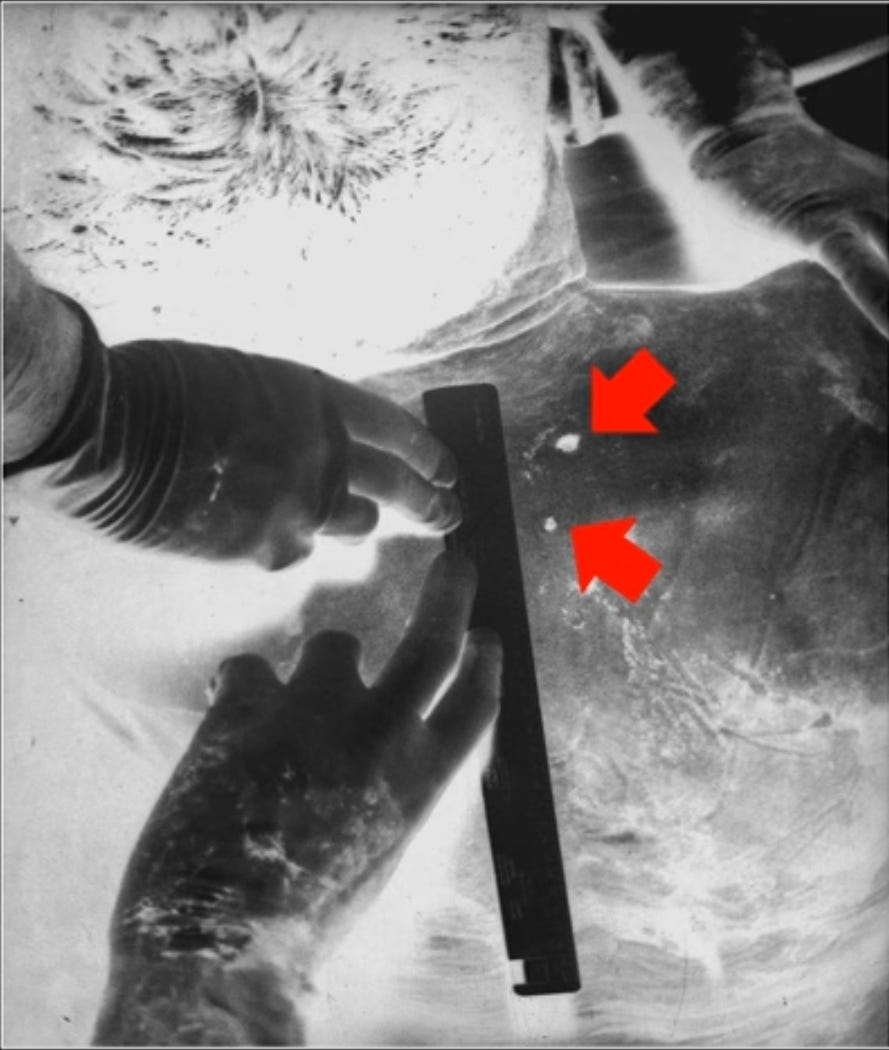
These holes are of a visibly different size. One of the men performing the autopsy described one of them as a 7×4 mm wound, a number very close to the 7.5 mm bullet found by the FBI.
X-ray analysis from Kennedy's autopsy revealed a fracture of the transverse process of the first thoracic vertebra. This finding was not noted in the original Bethesda autopsy report but was later identified by the House Select Committee on Assassinations. The autopsy report and x-ray findings also documented contusions of the apex of the right lung and the parietal pleural membrane over it, indicating trajectory from the front.

At Bethesda Hospital, lead pathologist, Dr. James Humes stated he burned his autopsy notes and the first draft of the report. Arlen Specter never pressed him as to why he did this.
Additional guns - Kennedy was supposedly shot with a Carcano, but a Mauser 7.64 was found by police in the northwest stairwell of the TSBD. This information was reported by news outlets in the early hours of the assassination and was also relayed by Sgt. Gerald Hill to a reporter for WFAA-TV.

A Mauser can be seen in CBS news coverage of the Carcano.
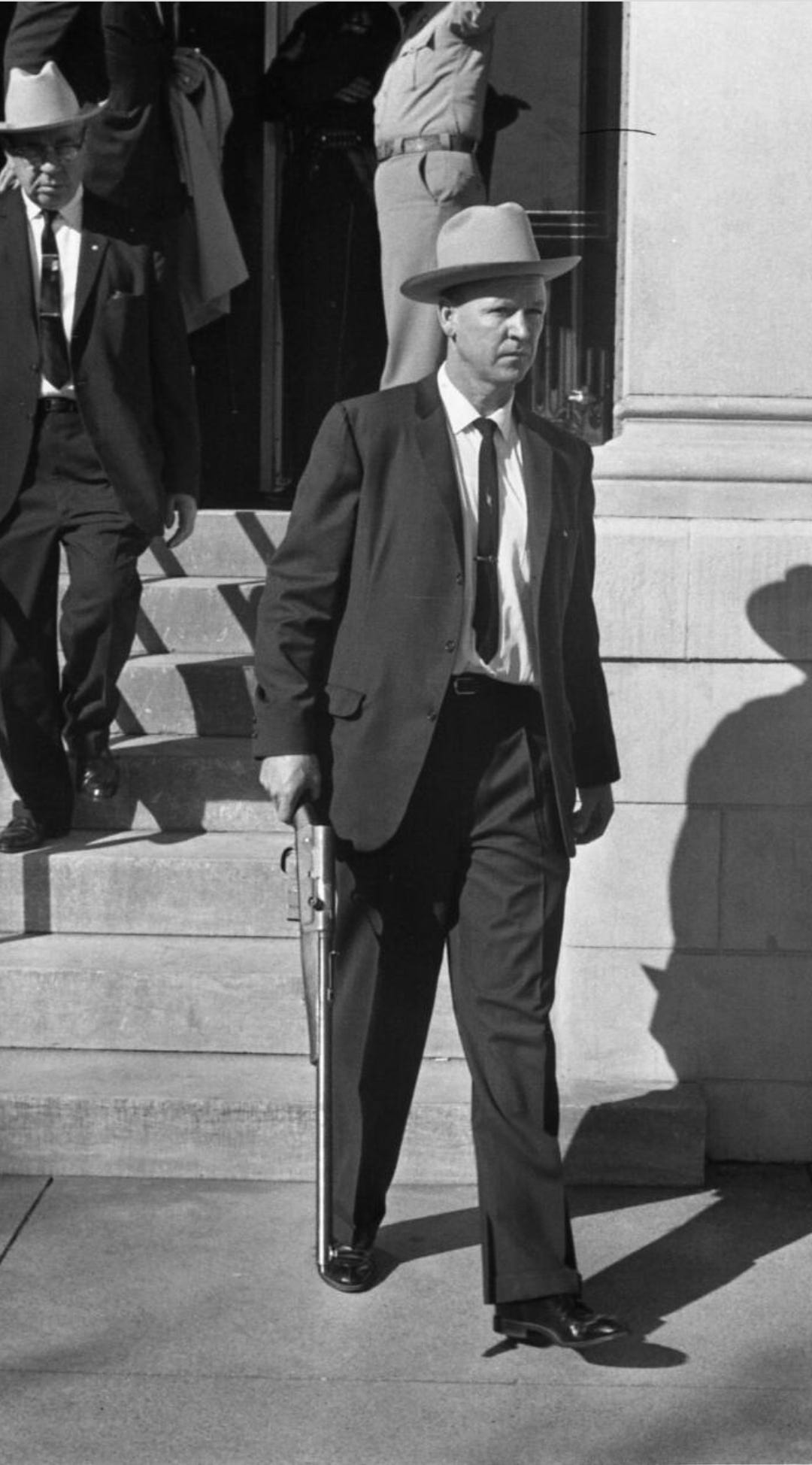
Detective Elmer Boyd can be seen carrying what looks like either a Mauser Cigarette rifle or a 1916 Model 8 Remington.


There was also a Johnson 30.06 rifle linked to mercenary, Loran Hall by the HSCA.

A man can be seen running away with what looks like the same gun in the Orville Nix film, which is exactly where it was cropped. This also confirms the testimony of an unnamed 14-year-old gun nut, who recognized the sound of a 30.06, and saw a man running away from the Pergola.
Additional Bullets - The Warren Commission concluded that three bullet casings were found under the window of the TSBD, however the original crime scene report indicates that only two hulls were collected. Looking at the updated version of this document, it appears as though someone has taken an ink pen and written 3 over 2.

Photographed was one live 6.5 munition round, obtained from captain Will Fritz. This was allegedly picked up and returned to the FBI by Cpt. J.W. Fritz, who had kept it as a souvenir. Different documents revealing the chains of custody contradict each other, with three hulls making their way from Lt. Day to Sims to Fritz; then two from Day to Brown to Williams.

Five bullet fragments were allegedly found in the limousine, in addition to the magic bullet which turned up on a stretcher at parkland, apparently not even one belonging to either Kennedy or Connolly.


This doesn't account for the 45. caliber slug found on the south side of Elm Street by Sheriff Buddy Walthers, the bullet signed in at an FBI lab by Robert Frazier, the bullet reportedly lodged behind Kennedy's ear, the 7.65 bullet found 10 days later which was inexplicably determined of no value and destroyed, or the second fully jacketed bullet found on the stretcher and kept by O.P. Wright because the Dallas police didn’t want it.
Either way, the magic bullet needed to be planted to link to Oswald's Carcano, or whoever else they might have blamed.
In 1967, Parkland personnel, O.P. Wright told authors that the bullet he had held did not look like the bullet which later turned up in FBI evidence. This claim was in conflict with a July 7, 1964 FBI memo which stated that it did look like the shell he had seen on the day of the murder. Wright said the bullet had a pointed tip; this description matches that of a bullet belonging to an Enfield 303, a gun found at the house of Buell Frazier, who drove Oswald into Dealey Plaza. This would indicate that, had Oswald gotten away, Buell Frazier may have been backup for a second patsy.
Witnesses - Skeptics might ask, if there was more than one shooter, why weren't there any witnesses?

Well, not only were their numerous witnesses, but many of them were either threatened or had their statements altered or omitted by the WC.
In total, there were 216 eye witnesses there that day. 57 said shots came from the knoll; 53 said shots came from the depository. The number of shots heard were 3 or 4, from multiple directions; this is backed up by 21 cops who rushed the picket fence and heard a shot come from the grassy knoll.

Ed Hoffman reported seeing two men, one of which was wearing a black hat and a blue jacket, who fired a rifle over the picket fence before tossing it to a man dressed as a rail road worker, who broke it down and put it in a tool box.
A man in a black hat with a high-powered rifle was also seen by a witness named Velma, who called into the Coast2Coast radio show in 2006.
A shooter from the pergola was spotted by an unnamed 14-year-old witness who spoke to the FBI.

Rail road supervisor, Sam Holland reported to the FBI to having seen a puff of smoke lingering above the picket fence above the grassy knoll.

Witness, Jean Hill told the police that she had heard around six shots from the picket fence. Hill would later claim to Jim Garrison that her statements had been altered in the WC report.

Similarly, witness Julia Anne Mercer claimed to have seen Jack Ruby dropping off guns at the grassy knoll. The green truck described by Mercer can be seen in both the Marie Muchmore and Robert Hughes videos. Muchmore's statements were also altered.
John Powell, an inmate being housed at the county jail reported seeing two dark skinned men with rifles on the 6th floor. Philip Hathaway reported seeing a rifle and a gun case while walking up Akard Street, described as having a dirty blonde crew cut.


Arnold Rowland and his wife saw a man with a high powered rifle through the 6th floor of the TSBD. They also saw a dark complected man in the opposite corner, with what was described as a face which was wrinkled or marked in some way. These men can just about be seen in the Robert Hughes film.
Ruby Henderson told the FBI she had seen two men on the 6th floor with rifles, one of whom seemed to be Mexican.

Caroline Walters also saw two men with rifles on what she had believed to have been the 5th floor.

Richard Randolph Carr was working on the 7th floor of the newly constructed courthouse, located on the corner of Houston and Commerce. He told the FBI he saw a man with a rifle on the 5th floor, then later saw him going down Houston Street to the corner of Commerce. He would later testify at the trial of Clay Shaw to having seen three men, including a Latin, exit the rear door of the TSBD, with two fleeing in a station wagon, and a third later being seen walking in a hurry, frequently looking over his shoulder, before also fleeing in a light colored station wagon. Carr would survive two separate murder attempts, wherein he would kill one of his attackers.
Motorist, Marvin C. Robinson also witnessed a green Rambler pick up a white man outside of the TSBD.


Dallas Sheriff, Roger Craig recalled a white man in his 20s running down the grassy knoll before being picked up by a Latin man coming down Elm Street in a light green Rambler. Roger Craig later identified this man from a picture shown to him by Jim Garrison.

Garrison, said he did not know who he was, other than that he had been arrested immediately after the assassination, but was let go because he didn't speak English. (We know who it was) Craig was later threatened, survived a car bombing, a car crash, got shot in the shoulder, then a month later allegedly committed suicide by a 0.22 Caliber bullet to the chest.

Tom Dillard, a photographer on the motorcade, also saw men on the 6th floor of the TSBD.
Joe Smith, J.C. Price, Lee Bowers and SM Holland, stated there was a shooting, loud noise, a flash of light, smoke by the pergola, bushes and fence, a man wearing a white shirt and trousers near the pergola, which we see in the Orville Nix film, a darker dressed man, a man in a car that had a telephone or walkie-talkie and fake secret service agents. Secret service agents were also seen at the back of the TSBD by officer D.V. Harkness.
Bill Newman was the closest witness to the limousine in Dealey Plaza, but was never called by the Warren Commission. He told the FBI that gun fire came from behind him from the Grassy Knoll.


Mary Moorman photographed what looks like a man with a hat behind the picket fence during the shooting, although her photo was not included by the Warren Commission. She stated that she was invited to provide testimony but asked for a postponement after an injury, and wasn't contacted again.

Ed Johnson reported people seeing puffs of smoke by the grassy knoll and police drawing their guns and running to the scene. Puffs of smoke can be seen in an enhanced version of the Dave Wiegman video.
Officer James Chayney was a motorcycle officer that was around 10 to 15 feet away from JFK; he stated that a second shot hit him in the face. He was never asked to testify to the Commission.
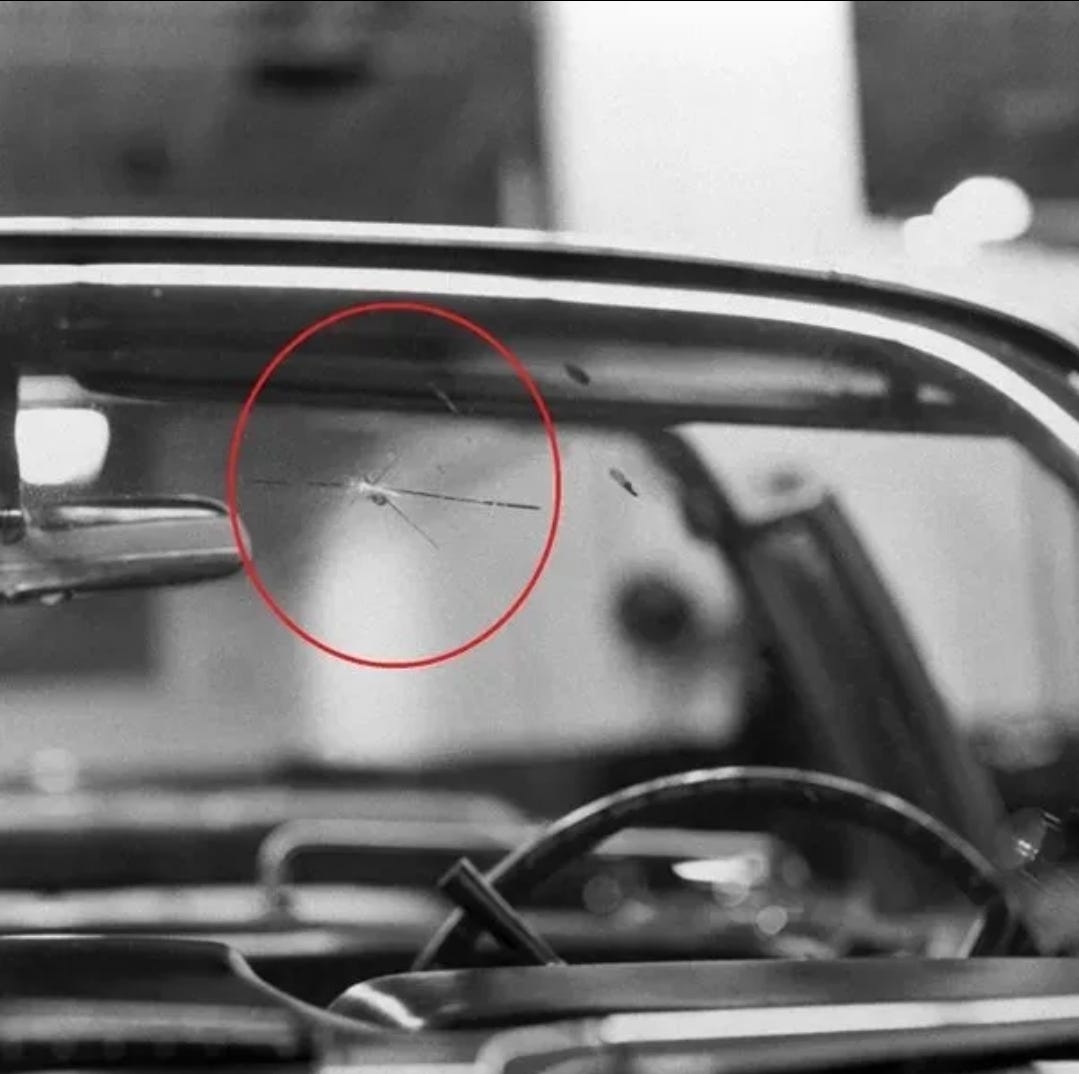
Multiple witnesses observed a penetrating bullet hole in the limousine windshield, which is also photographed.
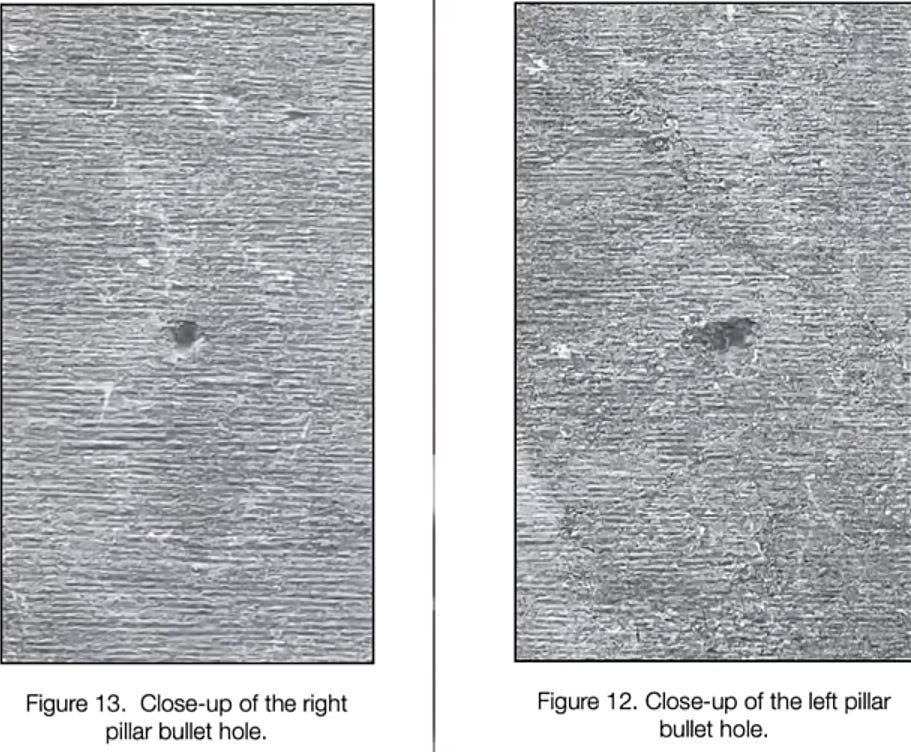
Similarly, secret service agent, Todd Hiles and Stewart Fillmore documented bullet holes on a pillar of the TSBD.
Two days before the assassination, two cops noticed several men aiming rifles over the picket fence. By hte time thy'd made it over, the men had fled in a car. This was reported to the FBI, who issued a report which was never mentioned by the Warren Commission, and disappeared until 1978 when it resurfaced thanks to a FOIA request.
Multiple arrests - The San Rafael California Daily Independent Journal evening edition on November 22, 1963 reported that in, addition to Oswald, a second suspect was also in custody”.

This might have something to do with the man in black being questioned by the police, while on of them holds a rifle.

Three Tramps - There's also the three tamps, who are not to be confused with the other three tramps arrested form a box car, identified as Gus Abrams, John Gedney, and Harold Doyle. Weirdly, John and Harold have reports on their arrests in 1963, but Gus has one in 1965, all on Nov. 22.
The tramps photographed were arrested from a coal car and taken from a Dallas jail house. They were about to get a gunpowder test but were let go after Oswald was arrested. Marvin Weiss, the officer escorting the three, clearly has a wire in his ear, although he claimed it was a wad of cotton.


Jim Garrison discovered a picture taken of a man arrested in Dealey Plaza after the assassination, who was let go because he didn't speak English.
Garland Slack said he saw someone take a young airman into custody.
Timeline anomalies and the Tippit shooting

The official story tells us that, despite numerous other bullets being found and only two shell casings in the snipers nest, Oswald fired three shots in 5.6 to 6.0 seconds, after which he allegedly zipped down five flights of stairs in 90 seconds to be witnessed getting a Coke.


Oswald was dropped off by a taxi at his house at 1:00 PM, then walked to 10th and Patton to shoot Officer Tippit at 1:16 PM. For this to have been possible, Oswald must have walked 8 miles in 16 minutes. Supposedly, after killing Tippit, Oswald made his way to the Texas Theater to watch a movie. Theater manager Butch Burroughs stated that Oswald entered around 1:00 and 1:17 PM, although Tippit was shot at 1:16; plus Tippit's body arrived at the hospital at 1:15 PM.

As for the bullets found at the scene, three of their impressions had a notch at the side, indicative of a semi automatic, while only one was completely round, suggesting it was fired from a revolver.

Motorist Domingo Benavides witnessed Tippit's killing, but refused to identify Oswald in a line up. In 1965, his brother Edward who resembled Domingo, was shot in the back of the head in a club in Dallas.

Helen Markham described Tippit's killer as being short and somewhat on the heavy side, with slightly bushy hair. Later Markham identified Lee Harvey Oswald in a police line up. Although considered a star witness, her testimony was full of mistakes. She said he was alive when the ambulance arrived, but the other witnesses said he died immediately. She also falsely claimed that for the first 20 minutes she was the only person to attend the body.

Aquilla Clemons described Tippit's assailant as chunky but short, and that he waved his hand at a skinny man in a white shirt and khakis, signaling him to go. She also said that a man came to her two days after the assassination, telling her it would be best if she didn't say anything because she might get hurt.
These men were also seen by George and Patricia Nash, who described them speeding off in a grey Plymouth. A grey Plymouth was reportedly driven by the shooter behind the picket fence described by Velma, driven by a man in a black hat. Ed Hoffman also reported a man in a black hat and a blue coat from the grassy knoll.

Like Aquilla Clemons, Doris Holan recalled Tippet's assailant as a heavy man who waved his hand to signal a second shooter, and like Hoffman, she recalled him wearing a blue coat. She also said: "if it wasn't him, it was his brother" in relation to the man she saw shot by Jack Ruby on TV.
By: Cory Hughes...
Raped by: Otto Heckel


No comments:
Post a Comment